
Mon to Sat 07 am to 06 pm
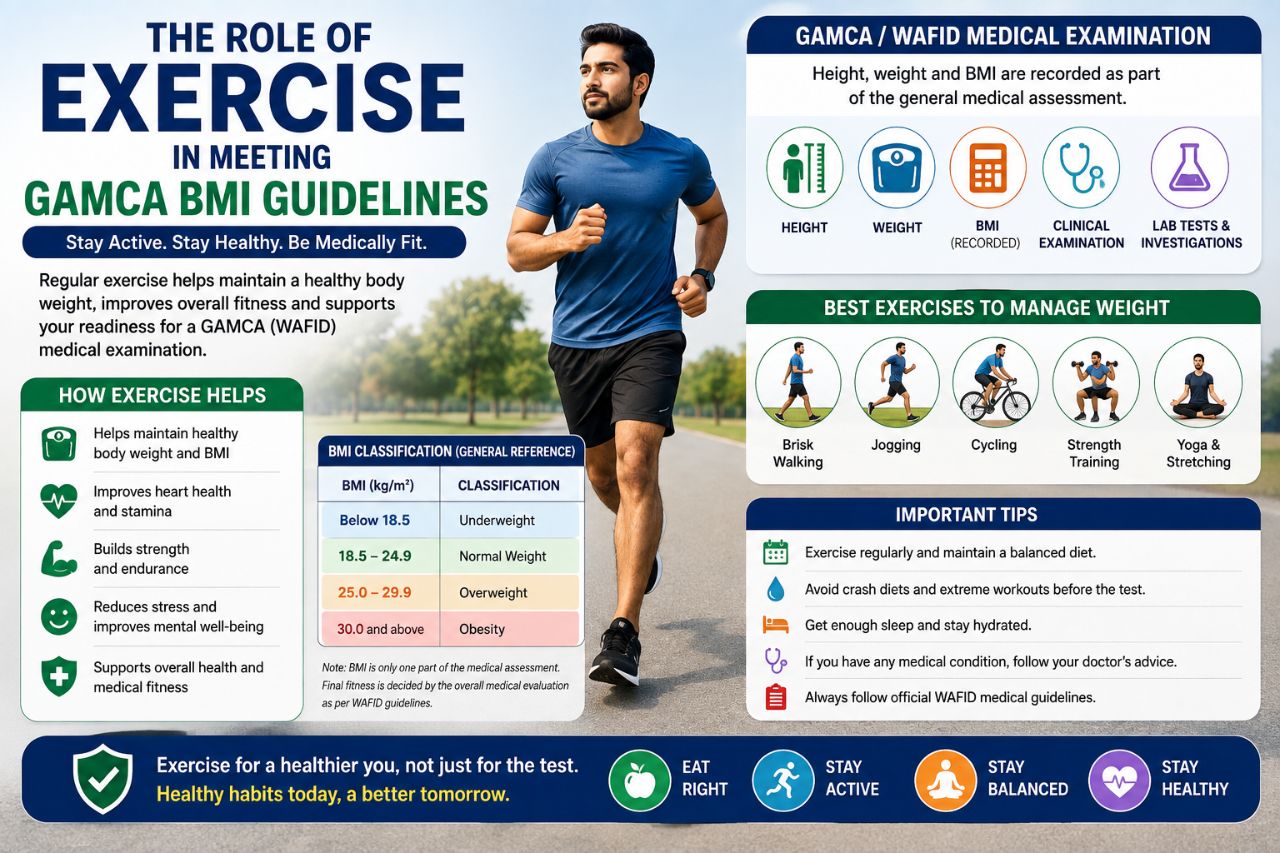
Exercise is an important part of maintaining a healthy body weight and preparing for a medical examination. For people planning to travel to GCC countries for employment or residence, understanding the relationship between exercise, body weight, BMI, and the WAFID medical examination can help them prepare more responsibly. The term “GAMCA medical” is still commonly used when referring to GCC medical screening, although the current system is managed through the WAFID program under the Gulf Health Council.
The WAFID medical examination records an applicant’s height, weight, and BMI as part of the general medical assessment. However, applicants should understand that BMI is only one recorded measurement and should not be treated as a standalone guarantee of medical fitness. The official WAFID medical examination framework includes several other clinical, laboratory, radiological, and health assessments.
Body Mass Index, commonly known as BMI, is a calculation based on a person’s height and weight. It is commonly used as a general screening measurement for assessing whether body weight falls within a particular range relative to height.
During the WAFID medical examination, the medical report includes fields for height, weight, and BMI. This means these measurements form part of the information recorded during the examination. Applicants can therefore expect their height and weight to be measured as part of the medical assessment.
Applicants often search for a specific “GAMCA BMI limit” or ask whether a particular BMI automatically results in an unfit medical report. It is important not to rely on unofficial claims about a fixed BMI cutoff.
The current WAFID medical examination regulations list height, weight, and BMI on the examination form, but the official material reviewed does not establish a universal BMI number as an automatic unfit criterion. The WAFID FAQ separately identifies specific medical conditions that can result in an unfit status, including uncontrolled hypertension, uncontrolled diabetes, renal failure, liver failure, heart failure, certain cancers, and other specified conditions.
Therefore, applicants should not assume that simply reaching a particular BMI through exercise guarantees a “fit” result. Medical fitness is determined through the overall examination and applicable WAFID requirements.
Although exercise should not be viewed as a way to manipulate or guarantee a WAFID result, regular physical activity can contribute to general health and healthy weight management. Exercise can help improve cardiovascular fitness, muscle strength, mobility, and energy levels when performed appropriately.
For someone preparing for a GCC medical examination, maintaining a regular and sustainable exercise routine can be a useful part of general health preparation. The objective should be to improve overall fitness rather than attempting rapid weight changes immediately before the examination.
Body weight is influenced by several factors, including diet, physical activity, sleep, genetics, age, and other aspects of lifestyle. Regular exercise can support weight management when combined with appropriate nutrition and healthy daily habits.
People who are above their preferred healthy weight may benefit from gradual lifestyle changes rather than extreme dieting or excessive exercise. Sustainable changes are generally more practical than attempting to lose a large amount of weight within a short period before a medical examination.
Walking is one of the simplest ways to increase daily physical activity. Applicants who do not regularly exercise can begin with comfortable walking and gradually increase their duration and frequency.
Regular walking can contribute to overall physical activity without requiring specialised equipment or a gym membership. Individuals with existing health concerns or physical limitations should consider appropriate professional advice before starting a new exercise program.
Activities such as brisk walking, cycling, swimming, or other aerobic exercises can improve cardiovascular fitness. Regular cardiovascular activity may also support healthy weight management when incorporated into an appropriate lifestyle.
Applicants do not need to undertake extremely intense workouts simply because they have an upcoming GAMCA or WAFID medical examination. A consistent routine maintained over time is more practical than suddenly increasing exercise intensity immediately before testing.
Strength exercises can help maintain muscle mass and physical function. Basic resistance exercises may include bodyweight movements or other forms of resistance training appropriate for an individual’s fitness level.
Because BMI is calculated using height and weight, it does not distinguish between muscle mass and body fat. This is another reason applicants should not interpret BMI as a complete assessment of health or physical fitness.
Exercise alone may not produce the desired changes in body weight if eating habits consistently provide more energy than the body uses. A balanced eating pattern alongside regular physical activity can provide a more sustainable approach to weight management.
Applicants preparing for a WAFID medical examination should avoid crash diets, prolonged fasting, dehydration, or other extreme approaches intended to change their weight quickly. The objective should be general health and well-being rather than trying to artificially alter measurements.
Starting an unusually intense workout routine immediately before a medical examination is generally not a sensible preparation strategy. Excessive exercise can leave a person fatigued or dehydrated and may interfere with normal daily functioning.
A better approach is to establish healthy habits well in advance. Applicants should follow any specific preparation instructions provided by their medical centre and inform medical professionals about relevant health or medication concerns when appropriate.
Regular physical activity can be part of a healthy lifestyle that supports cardiovascular health. Blood pressure is also recorded during the WAFID medical examination, and the official WAFID FAQ identifies uncontrolled hypertension among the conditions that can result in an unfit status.
However, exercise should not be considered a substitute for medical treatment. Anyone who has diagnosed hypertension or takes blood-pressure medication should follow their healthcare professional’s advice rather than attempting to manage the condition independently before a WAFID examination.
Physical activity can be an important component of general diabetes management, but people with diabetes should follow individualised medical advice. The WAFID FAQ lists uncontrolled diabetes among the conditions evaluated as unfit.
Applicants with diabetes should therefore focus on appropriate long-term health management rather than trying to change blood glucose levels through excessive exercise shortly before their medical examination.
There is no official WAFID rule stating that an applicant must exercise for a particular number of days or weeks before a medical examination. Exercise requirements should therefore not be confused with WAFID medical requirements.
If an applicant wants to improve their fitness or manage body weight, it is generally more useful to develop a sustainable routine well before the appointment rather than beginning a demanding program a few days beforehand.
This is an important distinction for applicants. Exercise may support overall health, but it cannot guarantee a “FIT” WAFID medical result.
The WAFID medical examination includes multiple areas of assessment. The official examination form includes general examination measurements, chest X-ray, blood pressure, pulse, respiratory rate, vision, hearing, laboratory investigations, systemic examination, and mental-status assessment.
Consequently, someone with a healthy BMI can still require further medical evaluation, while BMI alone should not be interpreted as an automatic reason for an unfit result.
Applicants can prepare by maintaining regular physical activity, eating a balanced diet, getting adequate rest, staying appropriately hydrated, and managing existing health conditions according to professional medical advice.
They should also ensure that their passport and appointment information are accurate. The WAFID system advises applicants to carefully check their information before submitting an appointment and to visit the assigned medical centre as soon as possible after generating the medical examination slip.
Rapid weight loss is not a reliable way to prepare for a WAFID examination. Extreme dieting or excessive exercise can create unnecessary health risks and does not guarantee a particular medical outcome.
If weight management is necessary, applicants should focus on gradual and sustainable lifestyle improvements. Individuals who have significant obesity, underlying medical conditions, or concerns about exercise should seek appropriate professional guidance.
One of the most important points for applicants is that BMI should be viewed in context. The WAFID medical report records BMI, but the examination includes many other assessments.
The current WAFID regulations include investigations and examinations covering areas such as blood parameters, liver function, kidney function, infectious disease screening, chest X-ray findings, vision, hearing, cardiovascular assessment, respiratory assessment, musculoskeletal examination, and mental-status evaluation.
This broader assessment is why applicants should focus on overall health rather than concentrating exclusively on their BMI.
One common mistake is believing that a specific BMI number automatically determines whether a person will receive a fit medical report. Another is attempting to lose weight rapidly immediately before the examination.
Applicants should also avoid relying on unofficial websites that promise a guaranteed WAFID medical result or claim that a particular exercise routine can ensure approval. The official WAFID system should remain the primary source for current medical examination information.
Yes. The WAFID medical examination report includes fields for height, weight, and BMI.
The official WAFID materials reviewed do not establish a universal BMI number as an automatic pass or fail criterion. BMI is recorded as part of the broader medical examination.
Regular physical activity can support healthy weight management and may contribute to a lower BMI when combined with appropriate nutrition and other healthy habits.
No. Exercise does not guarantee a fit result. WAFID medical fitness involves a broader assessment that includes clinical, laboratory, radiological, and other examinations.
There is no official requirement to perform intense exercise before a WAFID medical examination. A consistent, sustainable approach to physical activity is more appropriate than sudden excessive workouts.
The WAFID FAQ identifies conditions including HIV, hepatitis B and C, malaria and microfilaria, leprosy, certain chest X-ray abnormalities, renal failure, liver failure, heart failure, uncontrolled hypertension, uncontrolled diabetes, certain cancers, psychiatric and neurological disorders, and certain physical disabilities among the conditions evaluated as unfit.
Exercise can play a useful role in maintaining healthy body weight and improving overall physical fitness before a GAMCA or WAFID medical examination. However, applicants should understand that the purpose of exercise should be long-term health improvement rather than trying to reach an unofficial BMI target immediately before the examination.
WAFID records height, weight, and BMI as part of the medical report, but BMI is only one component of a much broader medical assessment. Applicants should therefore concentrate on maintaining healthy lifestyle habits, managing existing medical conditions appropriately, and following the current WAFID examination requirements. Most importantly, they should rely on official WAFID information rather than unofficial claims about specific BMI limits or guaranteed medical outcomes.